What becomes possible when we meet peers not only in conversation, but in the places where they live, work and create?
C*SPACE Berlin was one of two hubs selected for the first Pan-European P2P Creators Exchange initiated by the European Creative Hubs Network. Our main peer partner and hosting hub was Nowhere, an independent bookstore and cultural space founded in Taipei by journalist and media entrepreneur Annie Jieping Zhang.
C*SPACE Berlin, the visiting hub, is an interdisciplinary creative hub in a former furniture factory in Berlin Weissensee, operating as a social enterprise with a focus on transcultural understanding, community-building and social and creative entrepreneurship.
For C*SPACE founder Katja, the journey brought together several strands of experience. Having lived and worked in mainland China, Hong Kong and elsewhere in East Asia for more than 15 years, she already had a long relationship with the Chinese-language sphere. Taiwan, however, remained largely unexplored apart from a short visit ten years earlier. Since relocating to Europe, her focus had shifted towards building C*SPACE in Berlin, while the Chinese-speaking and Asian diaspora communities remained natural collaborators and partners alongside other local and international creatives.
Returning to East Asia offered fresh perspectives on questions already central to C*SPACE’s work. The following key question builds on and further develops the objectives set out at the beginning:
How can C*SPACE and other transcultural hubs move beyond being connectors and space-makers to designing the conditions for different communities to meet, relate, co-create and shape shared spaces being globally connected while staying rooted locally?
These were some of the questions Katja carried into the peer learning visit. She approached the journey through the method of flânerie, weaving the peer learning activities into a journey of walking, listening, meeting people, entering spaces and following threads.
Creating Starts with Relating
The flânerie began at Nowhere’s bookstore in downtown Taipei, where the encounter started not with organisational presentations, but with stories, and hands-on work.
Annie and the Nowhere team invited Katja into a zine-making workshop centred on a question that immediately connected the personal and the professional: How do we relate to place through our stories and biographies? What happens to our relationship with a place when we move, migrate, or build our lives across different regions?
Working with paper, collage materials and other creative supplies, we first explored and shaped our personal stories through a hands-on, intuitive process. Only afterwards did we put them into words and share them in a presentation. Before talking about organisations, programmes or strategies, we had the opportunity to encounter one another as people in a rather intimate way. Our zine-making workshop question also tapped into the heart of Nowhere. Its Chinese name, 飛地 fēidì, literally refers to an “enclave”: a territory belonging to one place while geographically situated elsewhere. Its English name, Nowhere, plays with the tension between nowhere and now here — between displacement and being present.
Nowhere began as an independent Chinese-language bookstore and cultural space in Taipei in 2022, and has since developed into a translocal network with physical and community nodes across Asia and beyond, with Tokyo as another important hub. In Europe, Nowhere is beginning to build its presence through its first partner bookstores in the Netherlands and the UK. Through books, talks, readings, festivals, publishing and zine projects, it explores how an independent Chinese-language public sphere can be sustained across borders, bringing together people from diverse Chinese-speaking backgrounds while remaining rooted in the local societies where its nodes operate.
As Annie explains, Taiwan’s independent bookstores are not only part of the book market but also part of the country’s civic and cultural infrastructure. Many small bookstores function as highly localised public spaces, combining bookselling with talks, publishing, community organising and engagement with social issues. This ecosystem is enabled by Taiwan’s democratic environment, freedom of expression, dense publishing culture and relatively active civil society, even as independent bookstores face familiar economic pressures around rent, labour and the declining profitability of bookselling itself.
Against this background, Annie described one important context for Nowhere’s work as “the geographical fragmentation of the Chinese-language public sphere.” She points to political repression in mainland China, the transformation of Hong Kong, migration across the Sinophone world and growing geopolitical tensions as factors that have displaced writers, journalists, academics, cultural workers and readers across many cities. “This creates both pressure and possibility,” she explains, as places such as Taipei, Berlin, Tokyo, London and Amsterdam offer new contexts in which Chinese-language cultural and civic life can be rebuilt.
From Connection to Rootedness
For Annie, the question is therefore “not simply how to connect a diaspora,” but how cultural infrastructure can be rebuilt across borders, enabling people to retain language, memory and relationships while becoming rooted participants in the societies where they now live. In this sense, Nowhere creates a kind of home away from home: connecting Chinese-speaking people across distance while also helping to build roots in the places and local societies where they live.
For C*SPACE, this offered a valuable perspective on the role that physical cultural spaces can play in an increasingly geographically fragmented and digital world. Both C*SPACE and Nowhere work from different starting points, but share an interest in creating places where people can meet openly, with curiosity and courage, relate across differences, exchange perspectives and participate beyond the immediate purpose of a program or institution. Especially for people whose lives are increasingly lived online and surrounded by political fragmentation and growing tensions, such physical places can create a different quality of social connection and human relationships, and provide spaces for belonging and participation in local communities.
The encounter therefore brought the question back to C*SPACE: what can European creative hubs contribute to helping people build not only connections across borders, but also roots and a sense of belonging in the societies where they live?
Following the Threads
While Nowhere was the main host and peer partner, the P2P journey invited Katja to follow the questions that emerged from the encounter into Taipei’s wider cultural landscape.
At the Goethe-Institut Taipei, a very different and more institutional setting, a conversation with the newly arrived director Björn Ketels and his team also touched on the idea of third spaces: How can a library become more than a place for lending books, a lively hub for meeting, exchange and connection? The conversation opened another question: Could there be potential for cooperation between independent cultural spaces and well-established institutions and what might each bring to the other?
At Treasure Hill Artist Village, Director Johan Chang introduced Katja to a unique place where artistic production, community, and urban, natural and spiritual dimensions meet. Its international fellowship and residency programmes raised another possibility: Could this open up new forms of exchange between Taipei and artists and cultural practitioners connected to European creative hubs? We also learned that Treasure Hill is planning to add a bookstore/library to the site, an interesting development in this context.
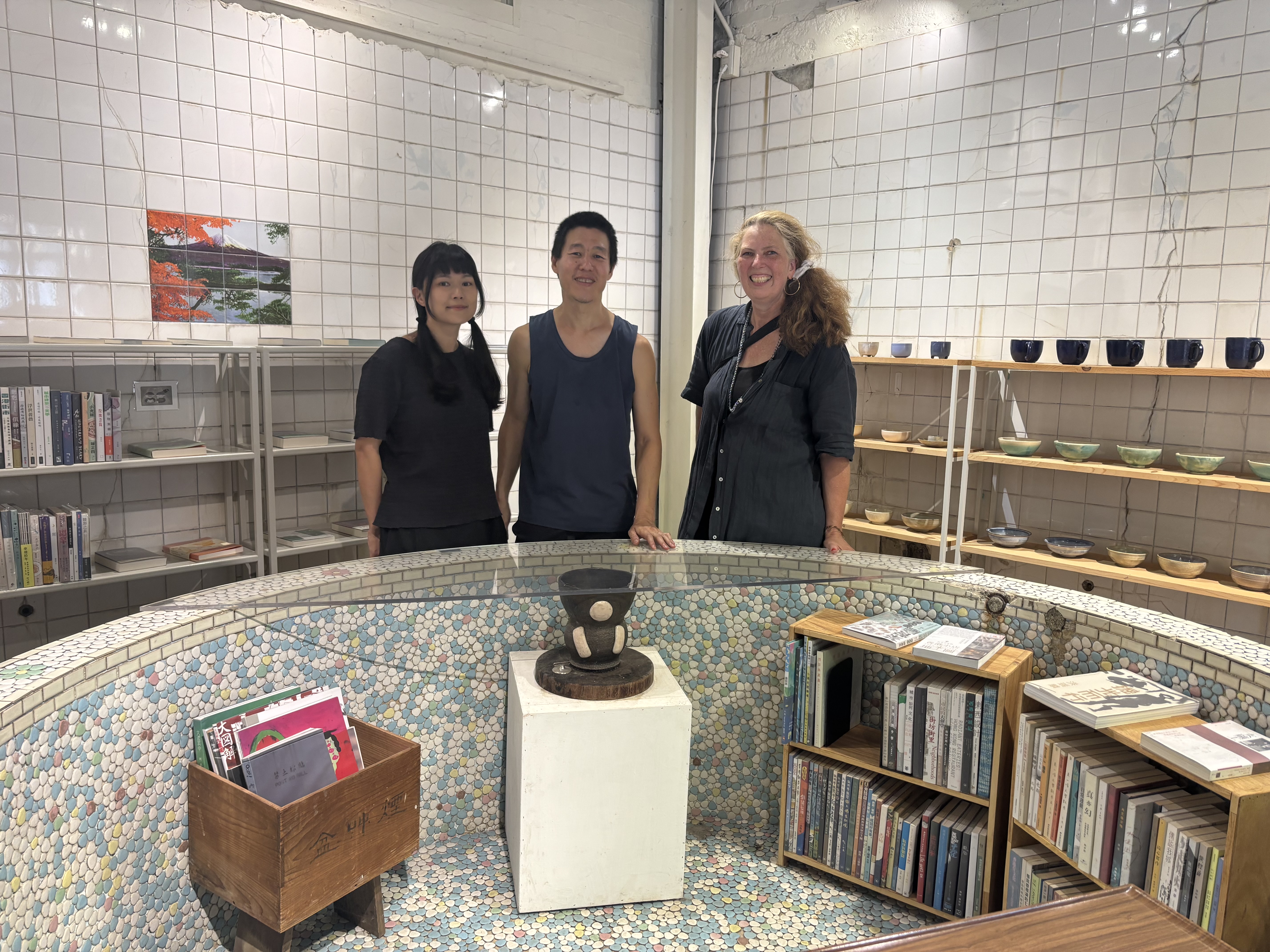
At Wo Gong 和工, an independent library and pottery studio in the mountains of San Diaoling, about an hour from Taipei, founded by A San 阿三 from Hong Kong and Bear Yen from Taiwan, the question became more intimate: What makes us choose a place? What makes a place become home? Wo Gong felt deeply rooted in nature, yet open to new lives and connections. Could nature offer healing and refuge , a place to feel at home away from home?
Making Spaces Work: From Business Models to Economic Relations
At Yimei Bookstore 郭怡美書店 and The Bookstore, two independent bookstore ventures that Willie Chang 趙偉仁 has helped develop and manage in Taipei, he offered a perspective that spoke directly to our second key question: how can cultural and community-based spaces develop sustainable financial models while retaining the human-centred purpose that gives them meaning?
Yimei Bookstore is located in a historic building in Dadaocheng, originally built in 1922 as the family’s trading house. Willie was involved in transforming the building into a contemporary independent bookstore while retaining its architectural and historical character.
Willie does not see himself primarily as a space-maker, but rather as a manager, whose contribution and service is to build the operating system of a space while also “tuning its spirit”. Before becoming involved with Yimei Bookstore and The 1 Bookstore, he had already developed and managed a youth hostel and other hospitality spaces in Taipei.
The conversation shifted our attention to management as a craft: to the skills needed to make a space work beyond its cultural vision. The question became very practical: where does the value created by a space translate into revenue? Part of it may come from the books themselves, but also from other services, experiences and activities around the space. Willie shared an interesting tendency: real-estate actors are approaching them because they are looking for ways to give otherwise empty spaces a social and cultural life that attracts and retains people. Could entirely new strategic partnerships or complementary businesses generate economic value that helps sustain the cultural space-making at the core?
At the same time, “tuning the spirit” made clear that this is not simply technical management. It also depends on the personal style, touch and character of the person running the space. Perhaps what a creative space produces is not always the thing it sells: sometimes, it is the ability to make a place feel alive, meaningful and worth returning to. The challenge is how to build an economic ecosystem that can sustain this value without reducing the space’s purpose to what can be directly monetised.
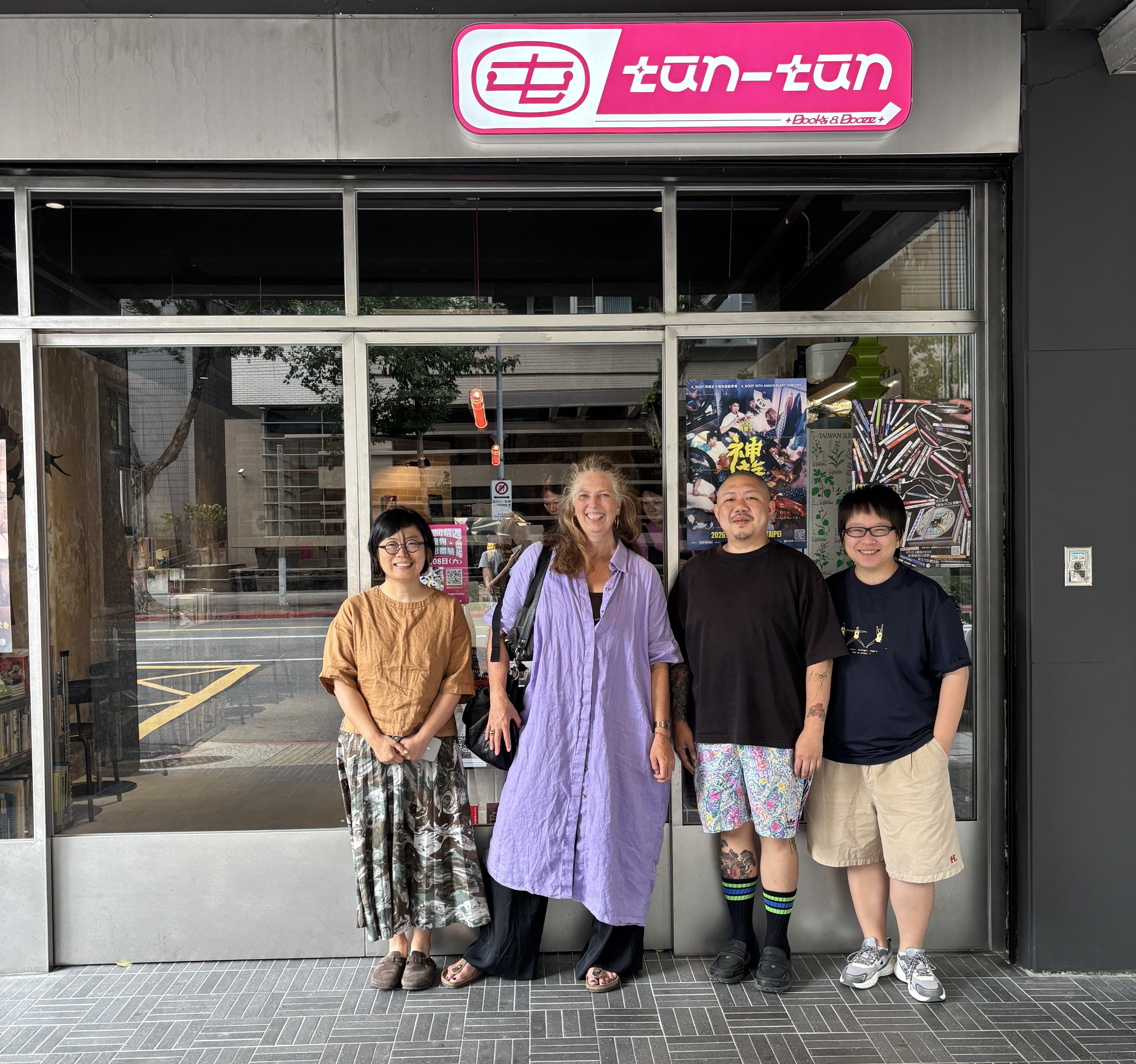
At Tun Tun 囤屯, a new bookstore, dialogue space and bar, Shu-Lei 舒磊, a lawyer and book lover, offered another model, not unfamuliar to some hubs in Europe: While his actual mission is to promote legal literacy, social justice and engagement with family history, he chose to create a physical space that also runs a bar and offers entertainment as one way of generating revenue. The bar is therefore not the purpose, but part of the economic model that helps make the cultural and social mission possible.
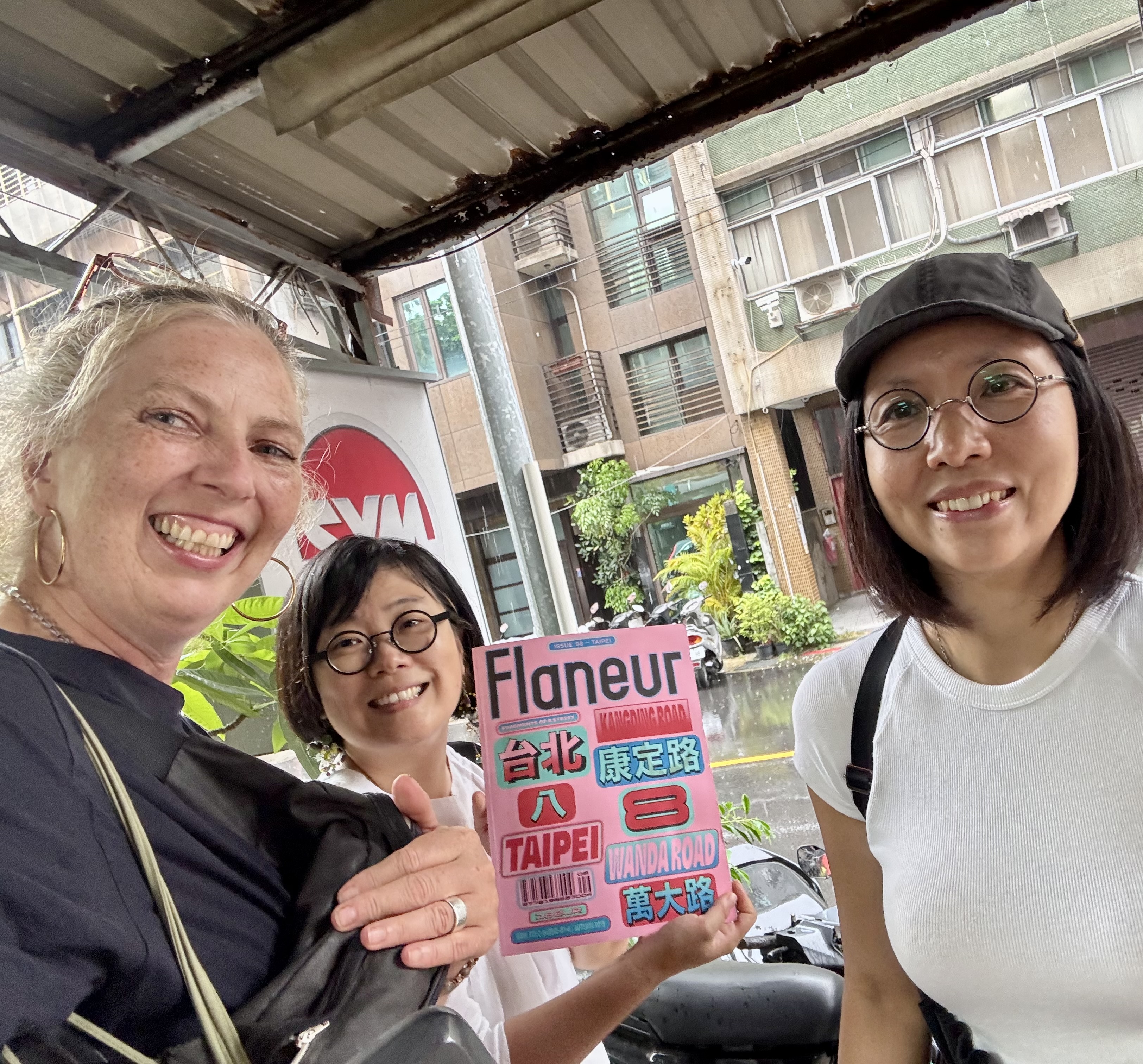
The conversation with Tang Wei 唐薇, a German Studies scholar, translator, former Executive Editor of Flaneur Magazine (2019) and content creation professional, who now works in Taiwan’s semiconductor industry, opened up the economic perspective beyond the individual space. What might connect us beyond chips, between Taiwan and Germany?
Her trajectory between language, culture, media and technology raised a broader question about translocal relationships: what other connections and forms of exchange might grow alongside the increasingly strong economic ties between Taiwan and Europe?
The Potential of Art, Looking Back to Europe
The final two encounters shifted the perspective back towards Europe, while also highlighting what creative hubs across different contexts and across oceans have in common.
At the Mekong Cultural Hub, Jennifer Lee 李慧珍 shared the mission of the International Society for Socially Engaged Arts: “Art is at the heart of every vital society.” The sentence resonated as a reminder that these questions are not specific to Berlin or Taipei, but point to a shared challenge for creative hubs across contexts: how can spaces that contribute to the social and cultural fabric of our cities be better recognised, supported and represented?
At Taiwan Contemporary Culture Lab, Curating Director Wu Dar-Kuen 吳達坤offered insights into contemporary cultural production through exhibitions including Bit Zero and WE Are Becoming 我們正成為. The latter’s understanding of identity as constantly changing and interconnected inspired Katja to ask: Could European diversity also be understood as an identity in the process of constant “becoming”, one that embraces cultures across Europe and is continuously reshaped by them? And how could a positive narrative of European diversity be told as a counter-story to increasingly national narratives of belonging?
What Does a Space Make Possible?
Across the encounters, one idea became increasingly tangible: a creative hub is not defined only by what happens inside it, but by the relationships it makes possible: relationships that can become part of the social fabric that holds communities together.
The public event hosted by Annie at Nowhere brought us back to a related question: How can spaces help us overcome polarisation and reconnect more fully, intellectually, socially, and simply as human beings?
The encounters offered no models to simply transfer to Berlin. Instead, they made the relationship between C*SPACE and its hosting hub, Nowhere, more tangible and personal. Experiencing each other’s physical environments created a greater sense of familiarity and trust, and shifted the relationship towards a more equal basis from which to take the next steps in collaboration.
The journey brought back more than souvenirs. It left a handful of seeds - accomplishments in their own right: a deeper connection to C*SPACE’s own practice; new ideas for spaces that communities across oceans and borders can genuinely embrace, shape and co-host; and a clearer sense of how human-centred purpose, sustainable economic models, translocal connections and local roots can come together. Alongside these reflections, it strengthened the relationship with Nowhere and opened new connections along the way, creating a basis for continued exchange and collaboration.
What Might Emerge from Here?
A flânerie is not about reaching a predefined destination. Something is shaped along the way: a field of encounters, understanding and curiosity.
From here, continued collaboration could grow step by step. The seeds picked up along the way are not only concrete activities, but also ideas for ‘designing’ C*SPACE as a space that different communities can genuinely embrace and make their own, reaching beyond CSPACE itself. Could C*SPACE become a hub of hubs, an anchorage in Europe for communities and initiatives from and across Asia? And perhaps what could emerge is not just a network of individual creatives and makers, but a community of community builders, hub leaders, peer learners and enablers, building roots and opening up possibilities for others. Some first concrete ideas discussed include a small Nowhere presence at CSPACE, manifested through a bookshelf in the CSPACE library bringing together Chinese-language, English and German books on the Sinophone world; a Storytelling Dinner Table as a community format; and perhaps, over time, larger joint activities around shared interests, such as a cultural festival.
Whatever form it takes, the deeper intention is global solidarity through local action: weaving translocal connections across cultures and boundaries, creating space for freedom of voice, diversity of perspectives and humanistic values in times of increasing ideological polarisation. Through the ECHN network, this weaving could extend further across Europe, to Amsterdam, Paris, Prague and other cities with larger Chinese-speaking communities, connecting creative hubs across different local contexts.
The P2P Flânerie ends. The weaving continues.